- Project
- Underway
A Board Game-Based Methodology for Interprofessional Medical Education

Joshua Juvrud Assistant Professor
Joshua Juvrud has a Ph.D. in Psychology (Uppsala University). As a research psychologist, his work has focused on the ways that novel techniques in research (eye-tracking, pupil dilation, virtual reality) can be used to assess how children and adults perceive and interpret people, emotions, and actions. Josh focuses this research in two fields. In developmental psychology at the Child and Babylab in Uppsala, he seeks to understand how children learn about their world and the social cognitive development of face perception and socialization processes such as gender, race, and ethnicity. In games research at the Games & Society Lab at the Department of Game Design in Visby, Gotland, his work examines the psychology of people, their actions, and emotions in game development, player engagement, learning, and immersion to understand better how different game players (with different personalities, traits, and experiences) interact with various game mechanisms and are, in turn, affected by game experiences.
-
Project start date :
2026/04/01 -
Status :
Underway -
Research organization :
Uppsala University -
Team :
/
In 2026, Game in Lab selected Dr. Joshua Juvrud's project to explore the potential of a board game as a novel training and research methodology for interprofessional medical education, with a particular focus on preparing healthcare teams for complex crises.
Project overview
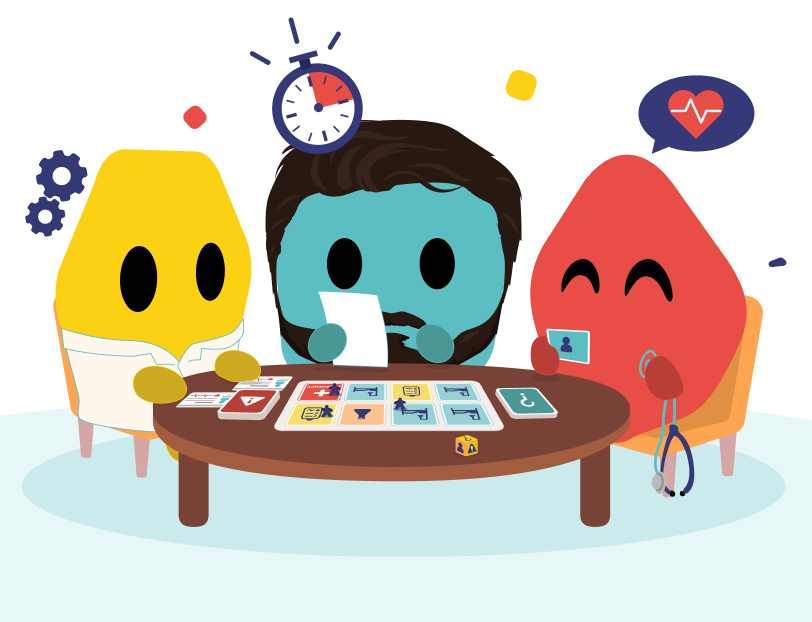
Traditional simulation-based learning has advanced procedural skills and clinical judgment but leaves a gap in training for systemic chaos, information asymmetry, and high-stakes decision-making. Drawing on principles of professional wargaming, the board game integrates mechanics such as time pressure, hidden information, and consequential choices to replicate the dynamics of real-world emergencies. The study will evaluate how this format supports key learning outcomes, including communication across professional roles, collaborative problem-solving, and decision-making under stress. By leveraging the hands-on, face-to-face, and collaborative qualities of physical games, the project aims to generate new knowledge about their pedagogical value in medical education
Methodology
This project uses a custom-designed board game as a research tool to study how healthcare teams collaborate and make decisions in complex, high-pressure situations. Inspired by professional wargaming, the game simulates chaotic medical crises where players have incomplete information, limited time, and distinct professional roles. By observing gameplay, conducting debriefings, and collecting pre- and post-session data, the researchers analyze communication, coordination, and decision-making processes. The game is iteratively refined throughout the study, making it both an experimental device and a way to generate new insights into team-based learning.
Outcomes
The project is expected to generate new insights into how healthcare teams communicate, coordinate, and make decisions in complex and uncertain situations. By analyzing gameplay data, the researchers aim to identify patterns of collaboration, strategies for managing incomplete information, and factors that influence decision-making under pressure. The study should also demonstrate the pedagogical value of board games as tools for interprofessional training, particularly for situations that are difficult to simulate with traditional methods. More broadly, it seeks to contribute to a better understanding of how games can function as research instruments for studying learning and interaction in high-stakes environments.
