- Project
- Underway
Roll for Initiative: Exploring the Use of TTRPGs in Social Care Settings

Gray Atherton Lecturer in Psychology
Dr Gray Atherton holds a BSc in Child Development from Vanderbilt University, an MEd in Counselling Psychology from the University of Houston, and a PhD in Educational Psychology and Individual Differences, also from Houston. She is a lecturer in Psychology at University of Plymouth and co-leads the Neuroplay Lab. Her research explores how neurodiverse people perceive the social world, focusing particularly on strengths in autism, anthropomorphism, human-animal interaction, and embodied social processing. She studies how movement, games (board, digital, VR), and special interests can improve mental health, social cognition, and reduce stigma. Before entering academia she worked as a counsellor for adolescents with neurodevelopmental conditions.
-
Project start date :
2026/04/01 -
Status :
Underway -
Research organization :
Plymouth University
Tabletop role-playing games are experiencing rapid growth and are increasingly attracting the interest of researchers and social care professionals. Beyond entertainment, they offer unique opportunities to foster engagement, creativity, and social interaction. This project builds on this momentum by exploring how these games can be used in a structured way within educational and therapeutic contexts.
Project overview
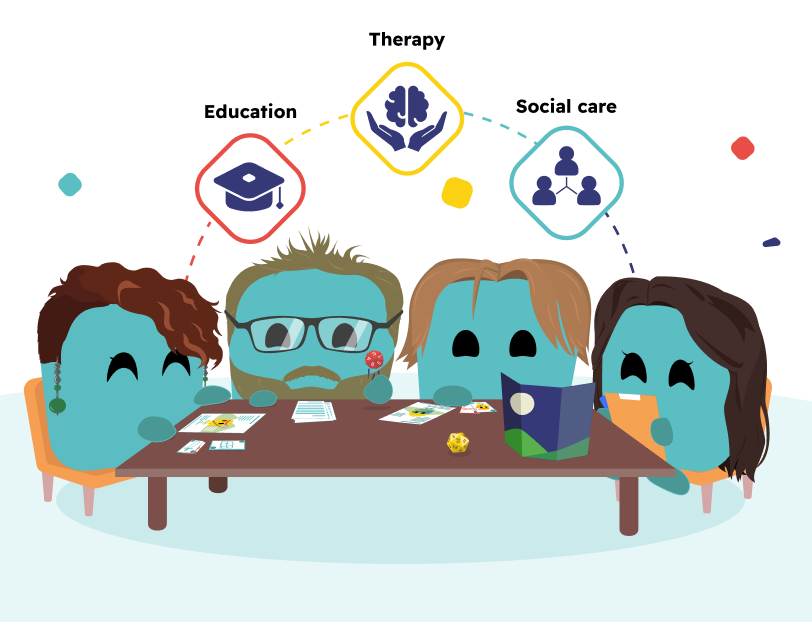
This project builds on prior work by Atherton and Cross, demonstrating that TTRPGs can enhance mental health, creativity, and resilience, particularly among neurodiverse individuals (Atherton et al 2025) , and on research by Germaine and Wake, which highlights how games, including TTRPGs, can engage learners through creative approaches that support collective action and ethical decision-making. Following this research, many professionals have shown interest in, or are already applying, TTRPGs within educational and clinical contexts. However, much of this work occurs in isolation. This project aims to bring practitioners together to document current practices, synthesise evidence, and develop a best practice framework for use in social care settings. Outcomes will include a white paper for educators and practitioners, a peer-reviewed Delphi publication on TTRPGs for social care, and a foundation for a larger UKRI grant currently being developed by Atherton, Cross, Germaine, and Wake.
Methodology
The project primarily relies on a Delphi study, a collaborative method in which experts come together to identify best practices, challenges, and future directions for using tabletop role-playing games in social care. Participants first engage in discussions during a workshop, then complete a questionnaire to reach consensus on key recommendations.
In addition, the researchers will produce a co-created white paper, combining the Delphi results with real-world case studies from practitioners, in order to provide accessible and practical guidelines for professionals.
Outcomes
The project is expected to produce two main outputs: an open-access white paper for practitioners, providing practical recommendations and case studies, and a peer-reviewed article based on the Delphi study, outlining the benefits, challenges, and best practices of using tabletop role-playing games in social care.
In the longer term, it also aims to build a network of practitioners and researchers and to lay the groundwork for a larger research project that will more rigorously assess the impact of these games on wellbeing and creativity.
