- Project
- Completed
Board gaming on the autistic spectrum

Liam Cross and Gray Atherton Lecturers in Psychology
Liam Cross is a Doctor of Psychology, and a Lecturer at the University of Plymouth. His PhD thesis focused on interpersonal and group relationships in relation to coordinated rhythmic movement. He then worked on various topics including the connection between the theory of mind and autism, as well as stereotypes in games.
Gray Atherton is a Doctor of Psychology, and a Lecturer at the University of Plymouth. She studies, among other things, how neurodivergent people perceive the social world and how the strengths related to neurodiversity help fight stigma.
-
Project start date :
2020/10/05 -
Status :
Completed -
Research organization :
Edge Hill University, University of Wolverhampton -
Team :
Dr Chelsea Slater and Dr Darren Chadwick (University of Wolverhampton)
In 2020, Drs Liam Cross and Gray Atherton’s project was selected to assess board games’ potential to promote and develop the social and cognitive skills of people (children or adults) with autism spectrum disorders. This project led to various scientific publications on the topic of board games in autism.
Project overview
The objective of this research project is to study how board games can be used to support the social and cognitive development of people with autism spectrum disorders (ASD), focusing specifically on social comprehension, pleasure and perspective taking, otherwise known as the theory of mind. The theory of mind is the ability to understand what another person thinks and consists of first- and second-order beliefs about the other. It is a cognitive function that is often impaired in people with ASD, which can explain social difficulties. Therefore, this project aims to study the practices and value of board games for people with ASD.
Methodology
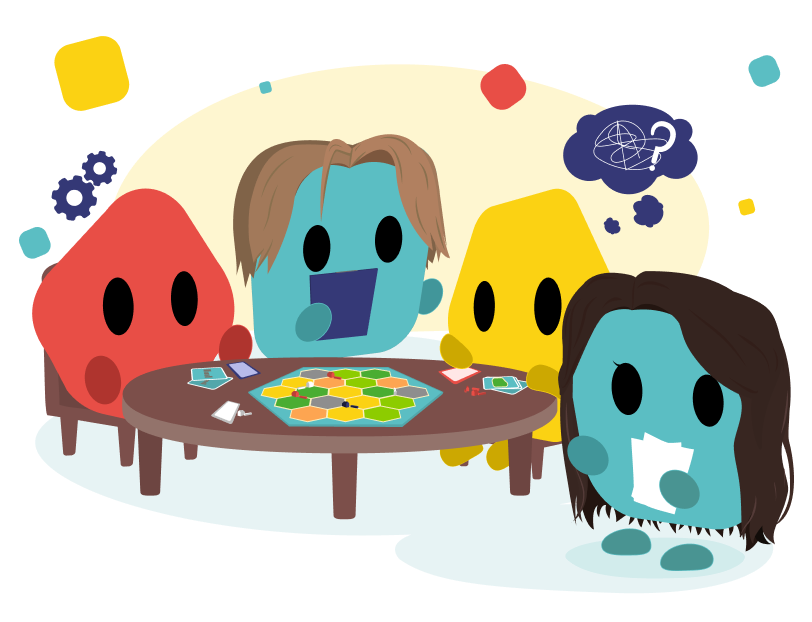
Four studies were conducted during this project:
- A survey on gaming practices among 1,600 board game players
- Interviews with players with ASD
- A focus group involving adults with ASD after a two-hour game session
- An intervention based on board games with children and adults with ASD in a school and community center, including interviews and observations of the players’ social and cognitive skills
Outcomes
Of the 1,600 board game players surveyed, 4.7% report a clinical diagnosis of autism compared to 1% in the general population. In interviews, players with ASD point out that board games are difficult but serve as a social lubricant. After a game-based intervention, sociability, cognitive performance, self-confidence and autonomy are improved.
