- Project
- Underway
Playing (and enjoying) “difficult” games while having a specific learning disabilities

Thomas Franco Pinto PhD student in Language Sciences
Thomas Franco Pinto is a PhD student in Language Sciences at the ICAR laboratory, Lumière Lyon 2 University. His thesis, funded by Asmodee, analyzes family interactions in a board game situation, with a focus on children diagnosed with specific learning disorders and their associated disorders. More particularly, it examines game play in families, through the organization of the activity, collaboration and commitment of players. Involved in leading the scientific world and an integral part of Game in Lab’s ambitions, Thomas is responsible for discussions with the international researchers collaborating with the program and leads regular private seminars in our scientific community.
-
Project start date :
2022/09/01 -
Status :
Underway -
Research organization :
ICAR Laboratory (Interactions, Corpus, Learnings, Representations, UMR 5191 CNRS), Lumière Lyon 2 University -
Team :
Prof. Heike Baldauf-Quilliatre and Dr Isabel Colon de Carvajal (Lumière Lyon 2 University, ICAR)
In September 2022, Game in Lab selected Thomas Franco Pinto to be its third PhD student under an industrial PhD contract. In partnership with Asmodee, and under the direction of Profs. Heike Baldauf-Quilliatre and Isabel Colon de Carvajal, he prepared his thesis in three years at the ICAR Laboratory (Interactions, Corpus, Learnings, Representations, UMR 5191 CNRS) of the Lumière Lyon 2 University.
Project overview
The study falls under the general field of Language Sciences, and more specifically the field of Conversational Analysis, which bases its analyses on audiovisual recordings of individuals in spontaneous and specific contexts. The detailed study of verbal and non-verbal interactions (gestures and looks) is used to draw up a complete picture of the conversation scene. This study addresses several key issues:
- Do specific learning disabilities impact young players’ game play experience? If so, at what level (reading, understanding the rules, strategy, concentration, visible and expressed pleasure, engagement and disengagement)?
- How does a child with learning disorders and/or their family adapt to a game of moderate complexity?
- How are any difficulties encountered circumvented or overcome?
- If observed, what are the notable differences in the practices of a child with learning disorders and a neurotypical child during the game play experience?
Methodology
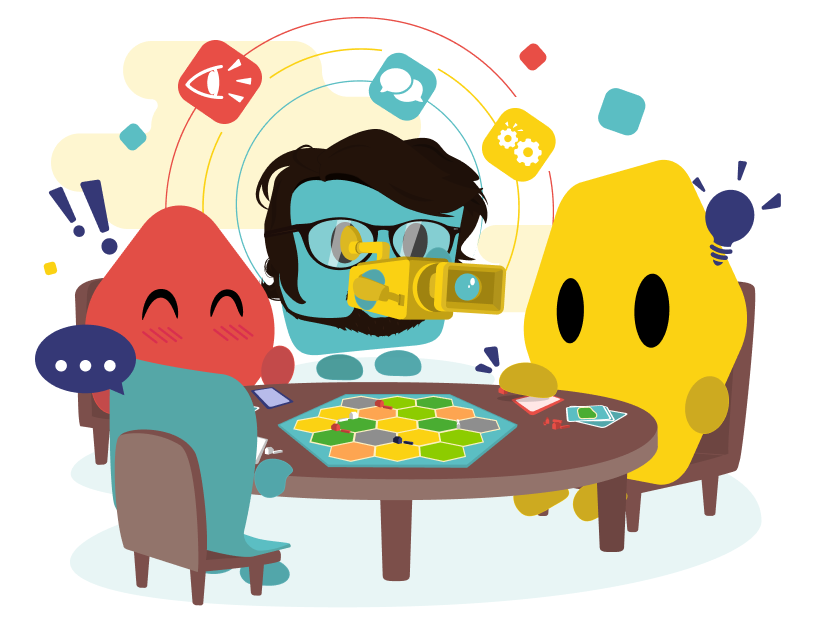
Participants play three different games, two of which are imposed: Timeline and Timeline Access +. Participants are free to choose the third game of moderate complexity, from the following: Catan, 7 Wonders, Pandemic, Carcassonne Shadows and Fog). The participants’ experience in the third game provides a global vision of the different families’ general practices in a game play situation, which are observed directly on the recordings made in the home.
Outcomes
In addition to the interest anchored in this project’s scientific research, potential results and conclusions will also allow an understanding and a vision of a wider spectrum of game play practices.
