- Project
- Underway
Playing and learning through engagement in fiction

Michael Freudenthal PhD student in Education Sciences
Michael Freudenthal is a PhD student at the Experice laboratory at Sorbonne Paris Nord University, which studied play for over 40 years. Their previous work focuses on collective participation processes in the act of playing and lead to publications on live role-playing and escape games. Their doctoral research is a field study in educational sciences and sociology, which analyzes fiction in the modes of participation and engagement in “modern” board game encounters. This research was supported by Asmodee through the Game in Lab program, where they worked on the development of the program and coordination of its sponsored scientific event.
Twitter : @playingresearch
LinkedIn : Michael Freudenthal
OrcID : Michael Freudenthal
-
Project start date :
2021/11/01 -
Status :
Underway -
Research organization :
EXPERICE Laboratory, University Sorbonne Paris Nord -
Team :
Prof. Gilles Brougère and Prof. Vincent Berry (EXPERICE, University Sorbonne Paris Nord)
In November 2021, Michael Freudenthal was awarded the second Game in Lab PhD funding under an industrial PhD contract. In partnership with Asmodee, and under the direction of Profs. Gilles Brougère and Vincent Berry, they are preparing their thesis at the EXPERICE laboratory at University Sorbonne Paris Nord.
Project overview
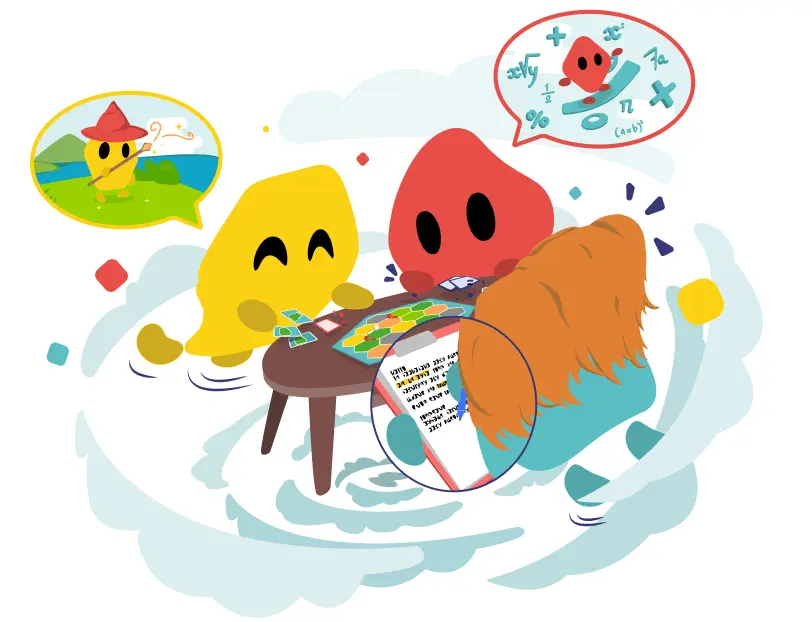
This research aims to analyze the social implications during participation in a board game encounter and in the place of fiction in its interactions. Cultural norms influence the learning processes that allow the group to play together, how individuals might become enthusiastic boardgamers, and others to completely withdraw from the practice. Crossing learning, participation and fiction will allow to answer, for example, the following questions:
- How do we learn to play so-called “modern” board games?
- What facilitates or prevents participation in the game? For whom?
- What are the respective roles of the group of individuals and of the game material?
- What is the role of fiction or imagination when we play? And afterwards?
- What do we learn without the intention or awareness of learning it?
Methodology
A field study was conducted over 4 years to assemble data from ethnographic observations and semi-directed interviews. It took place during encounters where board games were played in the Île-de-France region around Paris. The events varied in their public or private spaces, online and offline, in their relationship to board games and the socio-demographics of participants. Semi-structured interviews take place shortly after a game, in order to question the specific experience of the game, and relied on the individual’s spontaneous talk while exploring their relationship to play, imagination and their cultural profile.
Outcomes
During the fieldwork, initial abductive analyses show dispositions and behaviors that are favored in public or private practices of recent board games. They also show the extensive influence of a specific play culture, porous with the board game editing environment, and how it carries norms and hierarchies, which are particularly made visible by the analysis of the relationship to fiction, with a gender and social class perspective. These first results need to be developed and tested on the vast empirical data collected before being published by 2025-2026.
