- Project
- Underway
CLEVER – Cognitive Load and Ergonomic Visual Evaluation in Research

Marcello Passarelli Research Scientist
Marcello Passarelli is a researcher at the Institute of Educational Technology of the National Research Council of Italy (ITD-CNR) with a PhD in Psychology, Anthropology, and Cognitive Sciences. His work focuses on the intersection of games, learning, and psychological well-being, with a particular emphasis on board games. With a strong background in research methodology, user experience (UX) principles, and quantitative analysis, he has authored numerous scientific publications on game design, playful education, and the ethical dimensions of play. His publications include a framework for the analysis of ergonomics in board games and a study comparing digital and hybrid versions of a board game for training.
-
Project start date :
2026/04/01 -
Status :
Underway -
Research organization :
National Research Council of Italy
The CLEVER project addresses a major gap in board game design: the lack of clear, scientific standards for visual and cognitive ergonomics. By studying how elements like typography, icons, and layout affect players’ understanding and experience, it aims to make games more accessible, intuitive, and enjoyable for a wider audience. Ultimately, the project seeks to better understand how game design shapes the pleasures and inclusivity of play.
Project overview
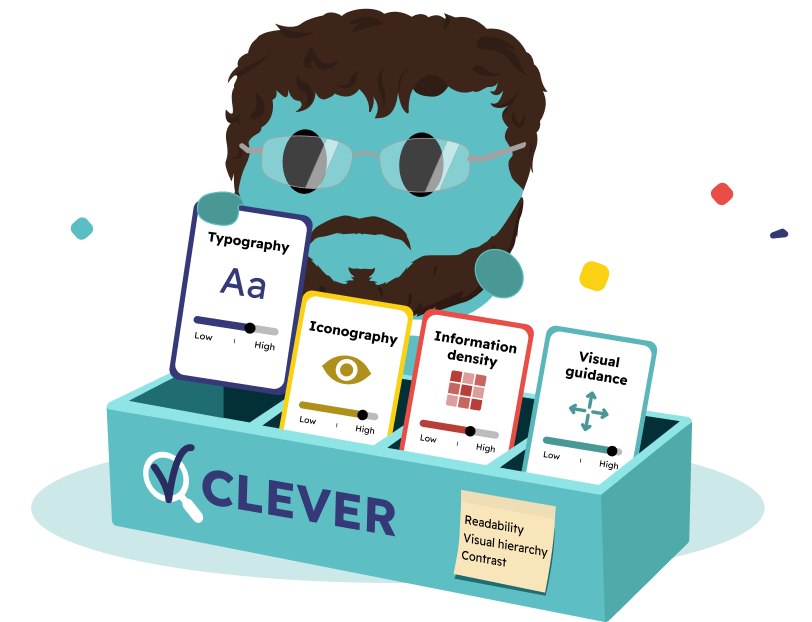
While digital interfaces are guided by robust, evidence-based standards like the Web Content Accessibility Guidelines (WCAG), the world of tabletop games operates without a similar foundation. This critical gap forces designers to rely on inconsistent, ad-hoc heuristics, often resulting in products with poor typography, ambiguous iconography, and cluttered layouts. These ergonomic flaws increase cognitive load, hinder learnability, and create frustrating experiences, disproportionately affecting first-time players, older adults, and participants with visual constraints. This not only limits the potential audience for games but also erects unnecessary barriers to the social and cognitive benefits of play. The CLEVER (Cognitive Load and Ergonomic Visual Evaluation in Research) project aims to solve this problem by producing the first scientifically validated framework for cognitive and visual ergonomics in board games. Our primary objective is to move the field from subjective intuition to objective measurement. The project will formalize a set of reliable operational metrics to quantify key usability factors, such as information density, visual contrast, readability, and icon comprehension. These metrics will form the basis of the open-access CLEVER Toolkit, a practical suite of guidelines, checklists, and calculation scripts designed to empower designers and publishers to create more accessible and inclusive products.
Methodology
The project follows a three-step approach. First, it builds a scientific framework by defining and quantifying visual and cognitive ergonomics in board games, using clear metrics and trained evaluators. Then, it tests these measures on a variety of games and players (about 100 participants) to see how design quality affects player experience, such as enjoyment, inclusion, and cognitive effort. Finally, the results are consolidated into practical tools, datasets, and guidelines to help both researchers and game designers improve accessibility and playability.
Outcomes
The project is expected to show that better visual and cognitive ergonomics in board games lead to a smoother and more enjoyable player experience. Games with clearer layouts, readable text, and intuitive icons should reduce cognitive effort, limit errors, and increase feelings of competence, inclusion, and enjoyment. It should also demonstrate that these effects are particularly strong for beginners, older players, and people with visual constraints, highlighting the importance of more accessible design standards.
